Blog
What goes (really) into the price of an exclusive wine-and-art journey across Europe?
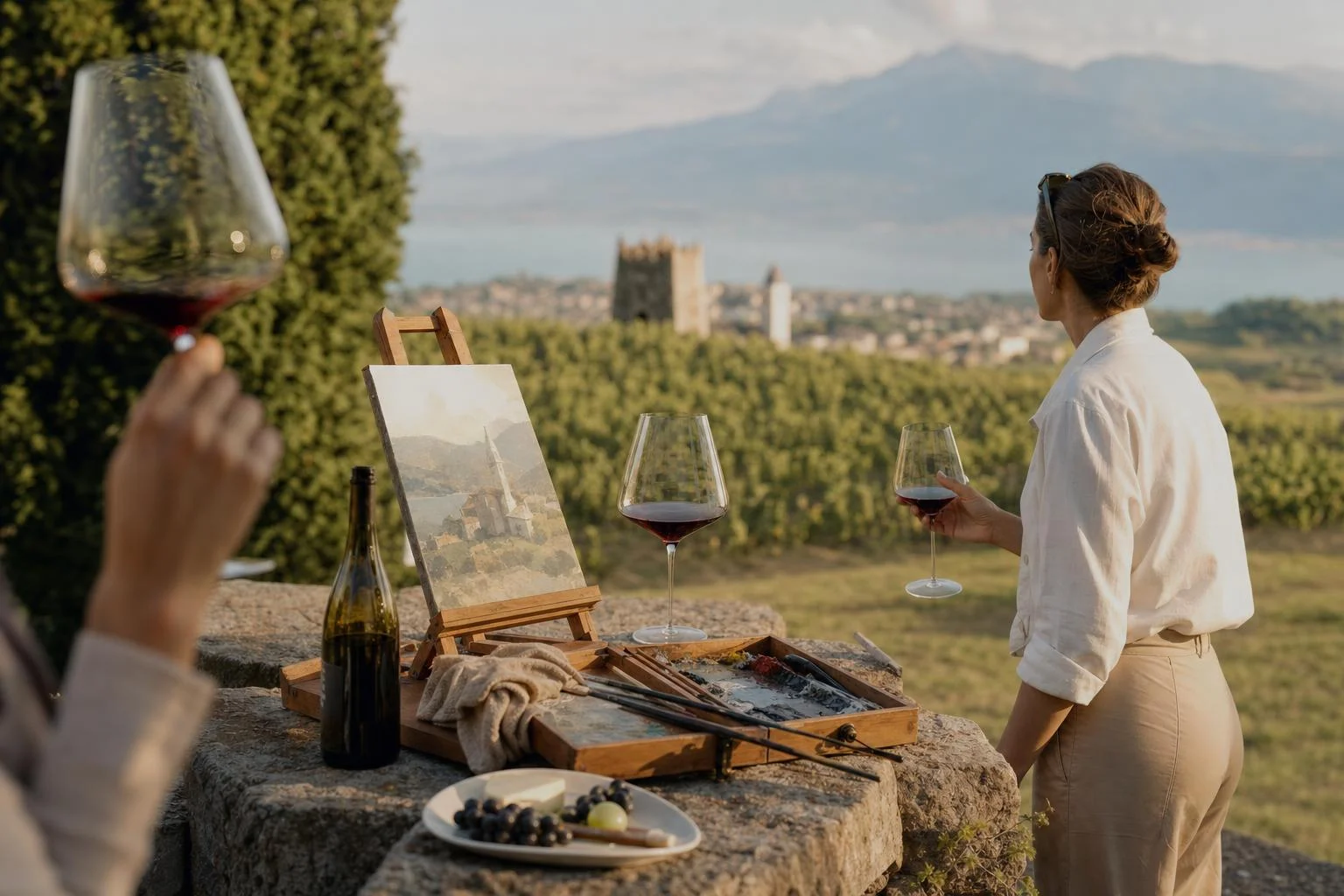
When a prospective traveller first sees the price of a well-crafted wine-and-art journey across Europe, the initial reaction is often one of surprise. Compared with a generic package holiday purchased online, the difference can be considerable. Yet that difference is neither a mystery nor a coincidence — it is the direct result of dozens of specific decisions, services and specialists behind every itinerary. This piece breaks the cost of a curated tour down into its component parts, explains the logic behind each element and gives you the tools to ask the right questions when making an enquiry.
Why a curated tour simply cannot be compared with a package holiday
A standard package holiday operates on economies of scale: the same hotel, the same coach, the same schedule for thirty travellers. The cost per person falls because everything is shared across a large number of participants, and the service is designed to satisfy the average of the group rather than any individual within it. A curated tour works on the opposite principle — it begins with you, your interests, your pace and your dates, and only then builds an itinerary around those parameters.
That fundamental difference in approach means that every segment of the journey carries its own cost, which cannot be spread across a large group. A private booking at a renowned Tuscan estate is not the same as a group tasting on a fixed schedule. A guide who is a sommelier holding European certifications is not the same cost as a tour escort following a rehearsed script. A stay at a boutique wine estate is not the same as a four-star chain property beside a motorway. Each of those differences has its price — and its value.
It is also important to understand that the organiser of a curated tour invests considerable working time before the journey has even begun. Researching destinations, negotiating with private cellars that are not ordinarily open to the public, coordinating with galleries, checking accommodation availability and crafting a personalised itinerary — all of this represents serious professional work that is not immediately visible, yet determines the quality of the experience.
Fees for specialist guides: sommelier, curator and art historian
One of the largest items in the cost of any curated tour is the fee for specialist guides. These are professionals with years of education and hands-on experience — certified sommeliers with an intimate knowledge of the particular terroir of individual regions, curators who have worked in respected European galleries, and art historians with an academic background. Their presence transforms a visit to a cellar or gallery from a mere stroll into a genuine intellectual and sensory experience.
It is worth bearing in mind that skilled specialists have limited availability and are in high demand. A sommelier who can guide you through a Barolo vertical whilst explaining vintages, soils and microclimate is not a free resource waiting in a hotel lobby. Such an expert has their own commitments, a fee that reflects their expertise, and a geographical range they cover. Depending on the destination and the guide's profile, the fee for a single specialist on a full-day engagement can be equivalent to a mid-range hotel night — or more.
For journeys that combine wine and art, more than one guide is often required, as these are distinct disciplines. The curator explaining contemporary sculpture in a Milanese gallery and the sommelier unpacking the complexity of Amarone are two different people with two different profiles. This item multiplies with the number of days and the number of destinations, which is why a multi-week European tour carries proportionally higher guide costs than a day trip.
Private cellar and gallery bookings: access that cannot be bought online
Many wineries and galleries visited on carefully curated journeys are not available through public booking platforms. These are private estates that receive guests only by prior recommendation and vetting, galleries that arrange special collection viewings outside opening hours, or cellars whose owners agree to tastings exclusively through a trusted intermediary. Building such relationships takes years and is one of the key values a good tour organiser brings.
The reservation of a private visit carries a cost that is structurally different from purchasing a ticket. Private cellars charge for the exclusivity of access, the preparation of special labels for tasting, personal guidance from the owner or winemaker, and sometimes the opportunity to purchase wines directly from the cellar on preferential terms. Galleries that open their storerooms or arrange meetings with artists have their own fees for such arrangements. These costs are real, transparent, and part of what you are paying for.
It is worth noting that private access is not merely a matter of prestige — it is often a prerequisite for genuine learning. During a private visit you can ask questions without being rushed, talk with the winemaker about a difficult harvest, and view works in a gallery storeroom that never appear in public exhibitions. This is content that simply cannot be replicated on a group tour, and the fee attached to it is a legitimate element of the overall cost.
Boutique accommodation: why location and atmosphere carry a price
Accommodation is the item where the difference between a generic and a curated journey is most readily seen. Organisers of exclusive tours typically select properties that are themselves part of the experience — an agriturismo set among vineyards, a small family-run hotel within historic walls, a boutique hotel housed in a building that was once a wine cellar or a small gallery. Such properties rarely offer discounts for large groups, as they have limited capacity and high occupancy throughout the season.
Beyond the room rate itself, the locational logic must also be considered. Accommodation chosen because it is five minutes' walk from the private cellar you are visiting the following morning, or immediately beside the gallery you are attending in the evening, carries a premium over a cheaper hotel on the edge of town requiring an hour and a half's drive. That logistical comfort has a value measured not only in euros, but in the quality of the experience and the rest you deserve.
Boutique accommodation in Europe's wine regions — from Burgundy to Chianti Classico, from Priorat to the Wachau — often includes breakfast with local artisan produce, dinner with the winemaker's family, or a tasting package that chain hotels simply cannot offer. When these elements are factored into the total cost, boutique accommodation can ultimately prove more economical than an expensive hotel chain that charges for each of those elements separately.
Transport: from transfers to private vehicles on the ground
Transport within an itinerary is one of the items most often underestimated at first glance. Private airport transfers, a hired minivan or chauffeured car waiting outside every destination, parking fees and road tolls in historic city centres, and first-class rail between towns — all of this feeds into the logistical budget of a journey.
For curated trips covering several destinations in a short time, private transport is not a luxury but a practical necessity. Burgundy's wineries are scattered across villages with no public transport connections. Galleries in Tuscany can be spread across three different villages thirty kilometres apart. Without private transport, precious time is lost; without a driver who knows the local roads and conditions, there is a real risk of arriving late to reserved visits with fixed time slots.
Sometimes the journey itself is part of the experience. Driving through the Côte d'Or vineyards in the early morning hours as mist lifts from the vines, or arriving at an island winery by boat rather than road — these are moments remembered just as vividly as the tasting itself. An organiser who plans transport with care adds value in those transitional moments of a journey, and that, of course, is reflected in the price.
A separate consideration is transport to and from the journey's point of departure — most commonly flights. Organisers of exclusive tours sometimes coordinate flight reservations as well, particularly when several participants need to be synchronised, or when there are specific requirements such as transporting purchased bottles of wine. That coordination, too, is part of a service that saves your time and peace of mind.
Hidden items that many forget to factor in
Beyond the four main categories, there are a number of smaller items that, added together, can account for as much as fifteen per cent of the total cost. Here are the most common ones that travellers overlook when making an initial estimate.
Travel insurance tailored to a high-value group — a standard policy does not always cover the full cancellation cost at a more significant level of investment. Translation and communication costs when dealing with private owners who do not speak English, for which an organiser may engage a dedicated interpreter. Reservation fees for Michelin-starred restaurants or private chefs preparing dinner at a winery. Insurance and packaging for purchased bottles of wine or works of art to be transported home.
There are also costs that arise independently of your presence: the organiser pays deposits for reservations weeks or months in advance, absorbs costs should the itinerary need to be adjusted due to weather or a closed destination, and continually invests in maintaining a network of partner relationships. These operational business costs legitimately form part of the final price, because without them the network does not function.
- Travel insurance with high cancellation cover
- Restaurant reservations and private chefs at wineries
- Translation and local communication with partners
- Packaging and insurance for purchased bottles or artworks
- Tickets and admission fees for museums and special exhibitions
- Operational deposits and organiser costs
How to read a proposal and what to ask when enquiring
When you receive a proposal for a curated tour, it is essential to understand the structure — whether the price is all-inclusive or whether certain items are charged separately. A good proposal clearly separates what is included (accommodation, transport, guide fees, private visits) from what is not (personal spending, wine purchases, optional excursions). Transparency in that breakdown is the mark of a serious and trustworthy operator.
Questions worth asking include: Which specialists are involved and what are their qualifications? Which cellars and galleries are visited, and is access genuinely private or shared with other groups? What is the cancellation policy and what happens if a destination becomes unavailable? What exactly is meant by accommodation — is breakfast included, are there alternatives? A serious operator will have a concrete answer to each of these questions, not merely a marketing phrase.
It is also worth considering the value ratio, not just the absolute figure. A journey that costs twice as much as a package tour, but includes access to an estate that is not open to the public, guidance from an expert who shares knowledge you simply cannot acquire elsewhere, and accommodation that is in itself a cultural experience — that is not a holiday that is twice as expensive. It is an entirely different experience that happens to come with its own price.
Ultimately, comparing proposals from different operators should be a comparison of content, not merely of numbers. Two proposals with the same total figure may have entirely different content, just as two different figures may represent a similar experience with different priorities. Take the time to understand what lies behind each item — that is the only way to assess the true value of what you are purchasing.
Understanding the cost of an exclusive journey is not merely an accounting exercise — it is a way of recognising the value behind each item. When you see a total figure, behind it lie hours of expert planning, a network of relationships built over years, the expertise of sommeliers and curators, access to places unavailable to the casual traveller, and accommodation that is in itself a cultural experience. If you are interested in a curated tour of European wineries and galleries and would like to know exactly what goes into your personalised proposal, get in touch with your idea, preferred destinations and dates — we will craft an itinerary suited to your interests and budget.
Frequently asked questions
Why is a private wine-and-art tour so much more expensive than a group departure?
A private tour does not spread the costs of guides, transport and reservations across a large number of participants. Each item — from the sommelier's fee to private cellar access — is paid for your group alone, but in return you receive a personalised itinerary, exclusive access and a pace that suits you and no one else.
What is included in the price of a curated tour?
It depends on the operator, but a quality all-inclusive proposal covers accommodation, private transport on the ground, specialist guide fees, private cellar and gallery reservations, and coordination of every detail. Personal spending and purchases of wine or art works are generally not included.
Can I afford a curated tour if I am not an expert in wine or art?
Absolutely. Curated journeys are not intended solely for specialists — the guidance of a sommelier or curator is precisely what makes them valuable for people who wish to learn and experience more, regardless of their prior knowledge. A skilled guide tailors their explanations to your level of interest and experience.
How far in advance should an exclusive tour of European wineries be booked?
For private estates and boutique accommodation during peak seasons (spring and autumn), booking at least two to three months in advance is recommended. Some destinations and wineries have limited capacity and long waiting lists, so the earlier you contact the organiser, the greater the choice of dates and venues.
Get in touch with an idea or your preferred destinations — we will craft a transparent, personalised proposal tailored specifically to you.
Request a Proposal