Blog
Sommelier, curator or art historian: who to choose as your guide on a wine-and-art journey?
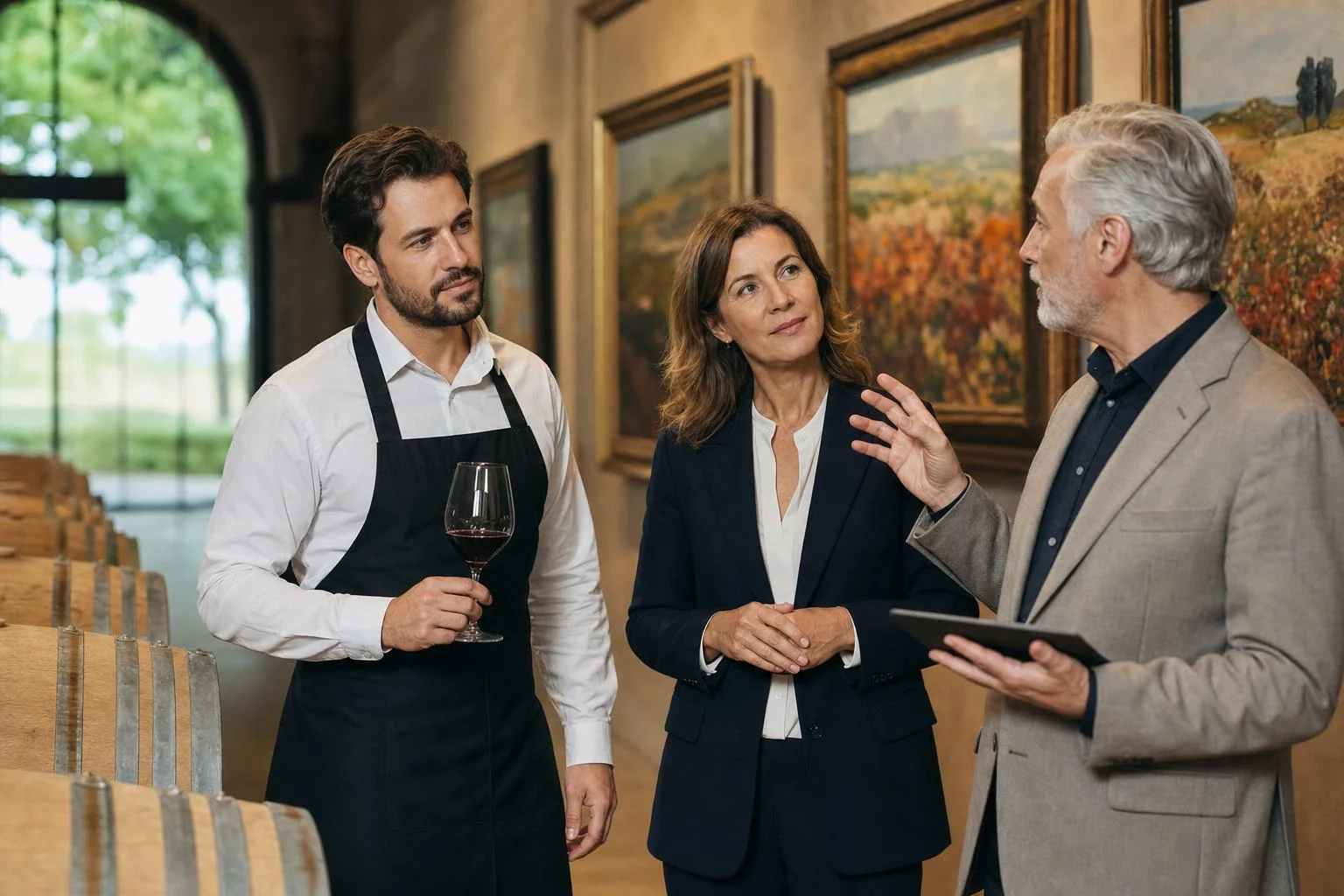
Imagine standing in the dim cellar of a Tuscan wine estate, a glass of red in hand, an endless forest of barrels stretching before you. Or strolling through the hushed corridor of a Parisian gallery that smells of linseed oil and aged canvas. Who is that voice beside you, turning the moment into an experience you will remember for years? Choosing the right expert guide — sommelier, curator or art historian — is no small matter. It is a decision that shapes entirely what you will hear, feel and carry home.
Why you need an expert guide at all — and why it matters who you choose
Wine estate visits and European gallery tours are, in theory, open to anyone who can use the internet and buy a ticket. Yet the difference between an independent visit and an experience led by the right specialist is much like the difference between reading a menu and actually sitting down to dine. Information is plentiful — context, narrative and a personal connection to a place are the elements that only a living, skilled individual can convey.
An expert guide does not read from a page what you could find yourself online. He or she brings years of accumulated experience, personal relationships with winemakers and curators, anecdotes that appear in no guidebook, and the ability to take your question — however tentatively put — and turn it into the starting point for a deeper conversation. Such a guide reads the room, adjusts the pace and knows when silence is more useful than words.
The three specialist profiles most commonly encountered in the context of wine-and-art travel — sommelier, curator and art historian — may at first glance seem interchangeable. Yet each possesses a different kind of knowledge, a different focus of attention and a different way of opening up the spaces you visit. Understanding those differences is essential to choosing an itinerary that truly suits you.
The sommelier: the language of wine, soil and tradition
At heart, a sommelier is a specialist in the sensory and cultural dimension of wine. Their training encompasses not only tasting and the identification of aromatic profiles, but also a deep understanding of geography — climate, soil, the microclimate of a particular vineyard — as well as oenology and the winemaking traditions of a given region. When a sommelier guides you through a vineyard in Istria or a cellar in Burgundy, they are not merely describing flavours; they are an interpreter of the landscape you hold in your glass.
Practically speaking, a sommelier helps you understand why Malvasia grown on Istria's sandy soils tastes entirely different from that cultivated on red clay just a few kilometres away. They explain what the term 'terroir' means, how the harvest and weather conditions of a single year leave a lasting signature on the wine you are drinking, and how a food pairing can dramatically change the experience of a glass. That kind of knowledge transforms a tasting from mere consumption into a conversation between you and the very place where the wine is made.
A sommelier is the ideal guide for those who experience wine as the primary reason for travelling — those who wish to learn to identify grape varieties, understand the differences between old and new producers, or who simply want to know how to talk with a winemaker in order to get the most from a visit. They are also a bridge between the winemaker and the guest: they know how to ask the right questions, translate technical jargon into accessible language, and ensure that a tasting never remains at the level of 'fruity, dry, pleasant'.
It is worth noting that a truly accomplished sommelier does not cease to be useful outside the cellar. In a restaurant, at an evening tasting, or when selecting a wine as a gift — the presence of a sommelier throughout the entire journey means that every meal becomes a continuation of the story that began in the vineyard.
The curator: an insider's view of galleries and collections
A curator is a specialist who lives within the systems of museums and galleries — they do not observe an exhibition from the outside, but in the truest sense co-create it. Curators work with artworks on a daily basis: they make decisions about arrangement, research provenance, negotiate loans, and sometimes spend years studying a single artist or a single work. When a curator explains a painting or an installation to you, those words carry an intimate knowledge not only of the work itself, but of the entire context in which it was created and in which it exists today.
The practical value of a curator as a guide becomes especially apparent in large collections — such as those at the Louvre, the Uffizi, or Tate Modern — where the volume of information is almost overwhelming and the risk of losing yourself in a sea of impressions is very real. A curator knows how to choose: rather than attempting to see everything, you will see the right things, and you will see them deeply. They also know what is not shown to tourists — hidden rooms, works in storage, conservation studios, stories of acquisitions that did not end as planned.
For lovers of contemporary art, a curator is irreplaceable. The language of contemporary art is sometimes deliberately hermetic, and without context it can appear cold or impenetrable. A curator draws you into the conversation that takes place within that community — what questions a particular artist is asking, which traditions they are responding to, why precisely this material or format was chosen. The difference between looking and understanding is enormous here.
A curator as guide is especially valuable if your interest is directed towards private collections, specialist galleries, or lesser-known institutions that do not attract mass tourism. It is precisely here that their personal contacts and reputation within the field open doors that would otherwise remain closed.
The art historian: the bigger picture and deeper history
While the curator operates primarily within an institutional framework, the art historian brings a broader, academic perspective that transcends the boundaries of a single gallery, a single period or a single medium. Their discipline is the reading of works of art as documents — visual testimonies of the times, ideas, economic relationships, religious beliefs and political forces that produced them. This makes them an exceptionally valuable guide when a journey encompasses different cultural periods or geographically diverse destinations.
Imagine a one-day itinerary that begins with a visit to a Romanesque church in the Dalmatian hinterland, continues through a Venetian palace with Renaissance frescoes and concludes in a contemporary gallery. Of these three profiles, the art historian alone can meaningfully bridge all three contexts — showing how ideas travel across centuries, how a single motif transforms across different styles, how local tradition absorbs outside influences while remaining recognisable.
The art historian is also an outstanding guide when the vineyard landscapes themselves become the subject. Many of Europe's wine-growing regions have been shaped by centuries of cultural heritage: Burgundian monasteries that defined the classification of individual plots, the Tuscan villa rustica as an architectural and agronomic project of humanism, Istrian hilltop settlements and ancient fortifications that speak of history accumulated layer by layer. The art historian reads that landscape as a sommelier reads a wine — as a record carrying far more than meets the eye at first glance.
For travellers who enjoy intellectual conversation, who experience travel as a form of education and who wish to understand not only what they are looking at but why it exists here, in precisely this form, the art historian is the natural choice. Those concerned that the journey might become a dry lecture will be pleasantly surprised: good art historians know that it is the story, not the catalogue, that captures the imagination.
At a glance: which profile suits which type of traveller
All three profiles share one defining quality: each is passionate about what they do, and that passion is contagious. Yet the differences are real, and worth examining clearly so that you can make an informed decision — whether you are planning a journey alone, as a couple or with a small group of friends.
- Sommelier: ideal for those for whom wine is the primary attraction, who wish to learn how to taste, understand terroir and establish a personal connection with winemakers
- Curator: ideal for lovers of visual art who wish to look beyond the descriptive label, particularly in specialist or contemporary collections
- Art historian: ideal for intellectually curious travellers who wish to understand the broader context — cultural, historical, philosophical — and who enjoy interdisciplinary connections
- Sommelier and curator combined: perfect for a journey that divides its time equally between wineries and galleries, with clearly distinct focal points
- Sommelier and art historian combined: excellent for a journey through a wine-growing region rich in cultural heritage (Tuscany, Burgundy, Istria)
- All three together: recommended for longer journeys with a diverse group of varied interests, where each day offers a different emphasis
How to combine all three profiles within a single itinerary
The most sophisticated solutions do not choose between these profiles but alternate between them thoughtfully within the same journey. A morning with an art historian explaining the wall paintings in an old-town palazzo, an afternoon with a curator in a contemporary gallery housed in a restored industrial space, then an evening with a sommelier who draws a common thread through everything seen, over a glass of local wine — this is a rhythm that does not exhaust but deepens each subsequent experience.
The key to a successful combination is narrative cohesion: the experts need to be acquainted with one another and with your interests, and to know where one context ends and another begins. When the art historian speaks in the morning about the role of wine as a status symbol in Renaissance painting, and the sommelier illustrates this in the evening with a tasting of wine made to an ancient recipe — the journey acquires a dimension not found in any commercial package.
Combining profiles is particularly valuable in groups with diverse interests. If one traveller is passionate about contemporary art and another prefers oenogastronomy, a shared itinerary that honours both is not a compromise — it is, in fact, richer than what either of them would have chosen independently. A well-organised programme with several guides achieves this synergistic effect naturally, without anyone feeling they are 'sacrificing' a day to something.
Of course, the logistics of a combined approach require an experienced organiser who knows all these specialists, can coordinate them, and ensure that transitions between activities are seamless rather than burdensome. This is precisely where the value lies in working with an agency that does not assemble its journeys from ready-made packages but builds them from the ground up, around the profile and wishes of each individual traveller.
Practical advice on choosing: questions worth asking in advance
When speaking with a journey organiser about the choice of guide, there are several questions that can help you define precisely what you are looking for. The answers are not merely an aid to the organiser — they are also a personal exercise that helps you understand your own priorities.
The first question: how much time do you plan to spend in wineries versus galleries? If the balance clearly tilts towards wine, the sommelier should be the constant, with other profiles brought in as needed. If the itinerary is evenly divided, it is worth considering two guides. If the focus is predominantly cultural and historical, with wine as accompaniment rather than protagonist, an art historian is the natural choice and can encompass the gastronomic context as well.
The second question: what kind of traveller are you? Do you enjoy asking questions actively and entering into debate, or do you prefer to listen and observe? Sommeliers and curators often lead interactive sessions, whilst art historians may be more accustomed to narrative exposition — though this varies from person to person. It is worth requesting a brief conversation with the guide before the journey itself: tone of voice, communication style, and the capacity to listen will reveal more than any biography.
The third question: is there a specific region or theme that particularly interests you? A wine region you have been reading about, an artistic movement you follow, an architectural heritage that fascinates you — whatever it may be, that information allows the organiser to find not merely a competent guide, but one who is personally specialised in precisely that area. The difference between a good guide and one who has spent years studying that specific vineyard, gallery, or movement is immediately apparent — and it is well worth seeking exactly that level of alignment.
Choosing between a sommelier, a curator and an art historian is not a dilemma with a single clear answer — because each brings something the other two cannot fully replace. The real question is actually a different one: what do you want to take away from this journey? A deeper understanding of wine and terroir, a more intimate relationship with the works you are viewing, or a broader perspective on the cultural history of the places you pass through? Once you know the answer, the right guide finds itself. And if the answer encompasses all three — so much the better. Contact Artvino & Co. and tell us what interests you: we will craft an itinerary with the right experts for your journey.
Frequently Asked Questions
Can a sommelier also lead a gallery visit, or must a separate guide be engaged?
A sommelier specialises in wine, oenology and wine culture — they are not trained to provide systematic interpretation of visual artworks. For a gallery visit it is always advisable to engage a curator or art historian, who not only knows the content but also understands how to navigate the institution and what hidden collections or displays actually mean.
What is the ideal group size for this kind of guided journey?
The optimal size for a personalised experience with an expert guide is two to eight people. In smaller groups the guide can adapt the pace and content to each participant, and visits to wineries and private galleries become conversations rather than lectures. Larger groups lose that intimacy, which is why organisers of quality tours keep numbers strictly limited.
Do I need prior knowledge of wine or art to feel comfortable with a professional guide?
Not at all. A good expert guide always starts from the level of knowledge and interest of their guests. What you need to bring is curiosity and an open mind — the guide adapts everything else to you, not the other way around. That is precisely the advantage of small, private programmes over group tours with a fixed itinerary.
How does a curator differ from a standard museum guide?
A standard museum guide largely recounts information available in catalogues and on descriptive labels. A curator is a specialist who has been actively involved in building or researching a collection — they know the context behind acquisitions, restoration processes, the stories behind individual works and the internal debates taking place within the institution. That difference in depth of knowledge and personal relationship with the subject matter is immediately palpable during a visit.
Tell us which themes and destinations interest you, and we will select and coordinate the right experts for you — a sommelier, curator or art historian. Every itinerary begins with a conversation.
Request a Quote