Blog
How to read a cellar's wine list: a short glossary of terms you'll hear during a tasting
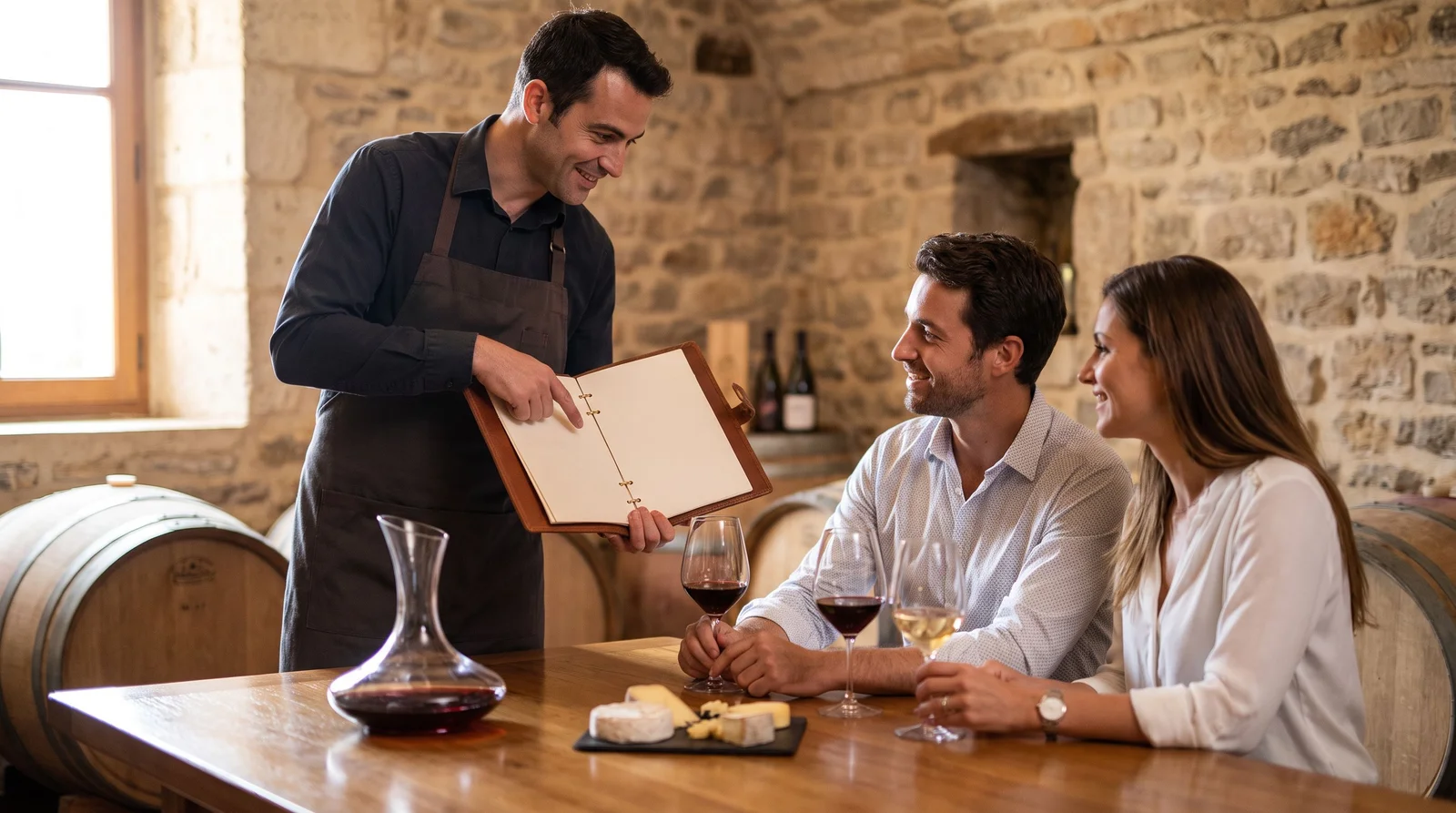
You're standing in a cold cellar somewhere in Tuscany or Burgundy, the sommelier slowly pours wine into your glass and rattles off a string of words — terroir, cru, malolactic fermentation, botrytis — and you nod, hoping the sound of your nodding masks the fact that you didn't understand half the sentence. There's no shame in that; wine language is centuries old and full of local terms that vary from country to country. This guide explains the terms you'll most often hear during a tasting at European wineries, without unnecessary jargon, so that next time you can enjoy the story as much as the wine.
Terroir, and why every winemaker mentions it first
Terroir is almost certainly the first word you'll hear, as it's the term winemakers consider the foundation of everything they do. It denotes the unique combination of soil, climate, terrain slope, sun exposure and local microflora that affects the grapes before they even reach the cellar. Two vineyards just a few hundred metres apart can produce completely different wines precisely because of differences in terroir — one might sit on limestone soil that lends the wine minerality, the other on clay that brings fuller body.
When a winemaker tells you that a wine 'reflects the terroir', they're essentially claiming that their role in the cellar was minimal — that they let the land and climate speak through the wine, without excessive intervention in the production process. This is also why the same grape varieties, such as chardonnay or sauvignon, can have an entirely different character in different regions.
It's worth remembering that terroir isn't just soil — it also includes microclimate (differences in temperature and wind within the same region), vineyard exposure (whether it faces south or north) and altitude, which affects the acidity of the grapes.
Cru, grand cru and riserva: what these designations actually mean
The term cru, particularly present in France, refers to a specific vineyard plot considered to produce wine of exceptional quality, recognised through a long history and a classification system. 'Grand cru' is the highest category and is reserved for the most prestigious plots — in Burgundy, for instance, there are only a few dozen across the entire region. 'Premier cru' is a tier below, but still denotes an exceptional location. These designations aren't a marketing trick but part of a strictly regulated classification dating back decades, even centuries.
In Italy, you'll more often hear riserva — a designation indicating that the wine has matured longer than the standard version of the same label, whether in barrel or in bottle, before being released to market. For Chianti Riserva this means a minimum of two years of ageing, while for Barolo Riserva the period can be even longer. Riserva usually also means that the grapes were selected from the best parcels of that year, so these wines are typically more complex and suited to longer storage.
Similar designations exist in Spain (crianza, reserva, gran reserva), which in turn denote progressively longer periods of ageing in barrel and bottle. When ordering or buying wine with these designations, it's worth remembering the rule: the 'higher' the designation, the fuller-bodied the wine usually is, with more pronounced tannins and better ageing potential, but also a higher price.
What happens in the cellar: maceration, malolactic fermentation and ageing
Maceration is the process in which grape juice remains in contact with the skins, seeds and, for some wines, the stems, before or during fermentation. It is from the skins that the wine gets its colour, tannic structure and part of its aromatic profile. For red wines, maceration lasts days or weeks, while for white wines the skins are usually separated quickly — except for so-called 'orange wine' or 'skin-contact' white wines, where the winemaker deliberately opts for extended skin contact to obtain tannins and an amber colour.
Malolactic fermentation, often shortened by winemakers to 'malo', is a secondary process in which sharper malic acid is converted into softer lactic acid with the help of bacteria. The result is a softer, creamier wine — which is why chardonnay that has undergone complete malolactic fermentation often has that familiar 'buttery' note. The winemaker decides whether to allow this process fully, partially, or avoid it altogether, depending on the style of wine they wish to achieve.
Barrel ageing is the next step that shapes the wine. Barrels made of French or American oak (barrique, usually 225 litres in volume) impart aromas of vanilla, smoke, coconut and spice, and their 'newness' plays a major role — a new barrel gives more pronounced woody aromas, while an older, already-used barrel acts more neutrally and serves more for micro-oxygenation, the gradual 'breathing' of the wine that makes it softer without adding too many woody notes.
Sweet wines and the terms that confuse people most: botrytis, passito, trockenbeerenauslese
Sweet and dessert wines have their own vocabulary that often confuses visitors because it combines German, Italian and French terms. Botrytis cinerea, better known as 'noble rot', is a fungus that attacks grape berries under specific humid conditions, drying them out and concentrating their sugars and aromas. It sounds unappealing, but it is precisely this rot that lies behind some of the most sought-after and expensive wines in the world, such as French Sauternes or Hungarian Tokaji.
Trockenbeerenauslese is a German term that literally means 'harvest of dry berries' — a designation for wine made from berries that have literally dried on the vine, whether through the action of botrytis or natural drying, and which contain an exceptionally high concentration of sugar. These are wines usually not drunk glass by glass but in small quantities, with dessert or blue cheese.
Italian passito works on a similar principle, but without the necessary action of botrytis: the grapes are harvested and then dried on straw, on racks or hung in airy rooms for weeks or months before pressing. Well-known examples are Vin Santo from Tuscany or Recioto from Verona. When a winemaker offers you a wine like this at the end of a tasting, it is usually a small, precious part of the production — these wines are made in small quantities because the process is lengthy and risky.
Terms for describing aroma and taste you'll hear as the wine swirls in the glass
Besides the technical terms about production, you'll also hear a range of expressions that sommeliers and winemakers use to describe the wine itself in the glass. 'Body' describes the sense of the wine's density in the mouth — light, medium or full-bodied, similar to the difference between skimmed and full-fat milk. 'Tannins' are compounds from the skin, pips and oak barrel that create that sensation of tightening and dryness in the mouth, especially pronounced in young red wines.
'Acidity' is the element that gives wine freshness and 'makes your mouth water' — wines from cooler climates, such as German Riesling, usually have more pronounced acidity than wines from warm Mediterranean regions. 'Length' or 'finish' refers to how long the flavour lingers in the mouth after a sip — a longer finish is generally considered a sign of greater quality and complexity.
Finally, the term 'minerality', often used but difficult to define, describes sensations reminiscent of stone, chalk, flint or sea salt in the wine — a quality many associate precisely with the terroir and the soil in which the grapes grew. There is no scientific consensus on the exact origin of this sensation, but nearly every experienced taster recognises and values it.
Practical tips for tasting without feeling uncomfortable
You don't need to remember every term to enjoy a tasting — even experienced wine lovers occasionally ask for clarification. The best approach is to ask questions naturally, at the moment a term confuses you: 'What exactly do you mean when you say this is a cru wine?' is a question every winemaker is happy to explain, since the love of telling the story of their own wine is part of the job.
It's also useful to keep brief notes, not necessarily formal ones, just a few words about each wine you taste — the region, the variety, one term you remembered and your own impression. After a few cellar visits, you'll start noticing patterns: you'll recognise the difference between a mineral and a fruity style, between wine aged in stainless steel and wine aged in oak, and the vocabulary will become part of your own experience rather than just other people's words.
At private tastings with a winemaker or sommelier, the pace is usually more relaxed than on mass tours, so you have the chance to return to certain terms, ask for comparisons between two wines, or ask why that particular year's harvest (vintage) is different from the previous one. It is precisely this kind of conversation, not just the tasting itself, that makes the difference between a tasting you forget and one you remember for years.
Wine language, like any language, is best learned through practice — glass by glass, question by question, in conversation with the people who make the wine with their hands and hearts. We nurture exactly these kinds of conversations, unhurried and with room for questions, on the journeys we organise through Europe's wine-growing regions. If you would like to visit cellars where you'll hear these terms explained directly by the winemaker, sommelier or curator, rather than reading them on a label, get in touch with us — we'll design an itinerary tailored to your interests and pace.
Frequently asked questions
Do I need to know all these terms before visiting a winery?
No, not at all. These terms simply make the tasting easier to understand and more interesting, but every good winemaker or sommelier will gladly explain anything that puzzles you during the visit.
What is the difference between the cru and riserva designations on a label?
Cru refers to the origin of the grapes, namely a specific vineyard plot recognised for its quality, while riserva describes the production process — longer ageing of the wine in barrel or bottle before release.
Why do some wines have a more pronounced woody flavour than others?
It depends on the barrel ageing: new barrels made of French or American oak impart stronger aromas of vanilla and smoke, while older, already used barrels are more neutral and mainly affect the wine's texture, not so much its flavour.
What does it mean when a winemaker says a wine has 'undergone malolactic fermentation'?
It means that the sharper malic acid in the wine has been converted into softer lactic acid, giving the wine a smoother, creamier texture — a common process for white wines such as chardonnay.
Get in touch with an idea or your preferred dates, and we will design a private journey through the wineries and galleries of Europe, with expert guides who are happy to explain every term.
Request a quote