Blog
August in Tuscany: why summer is the ideal time to visit its wineries and galleries
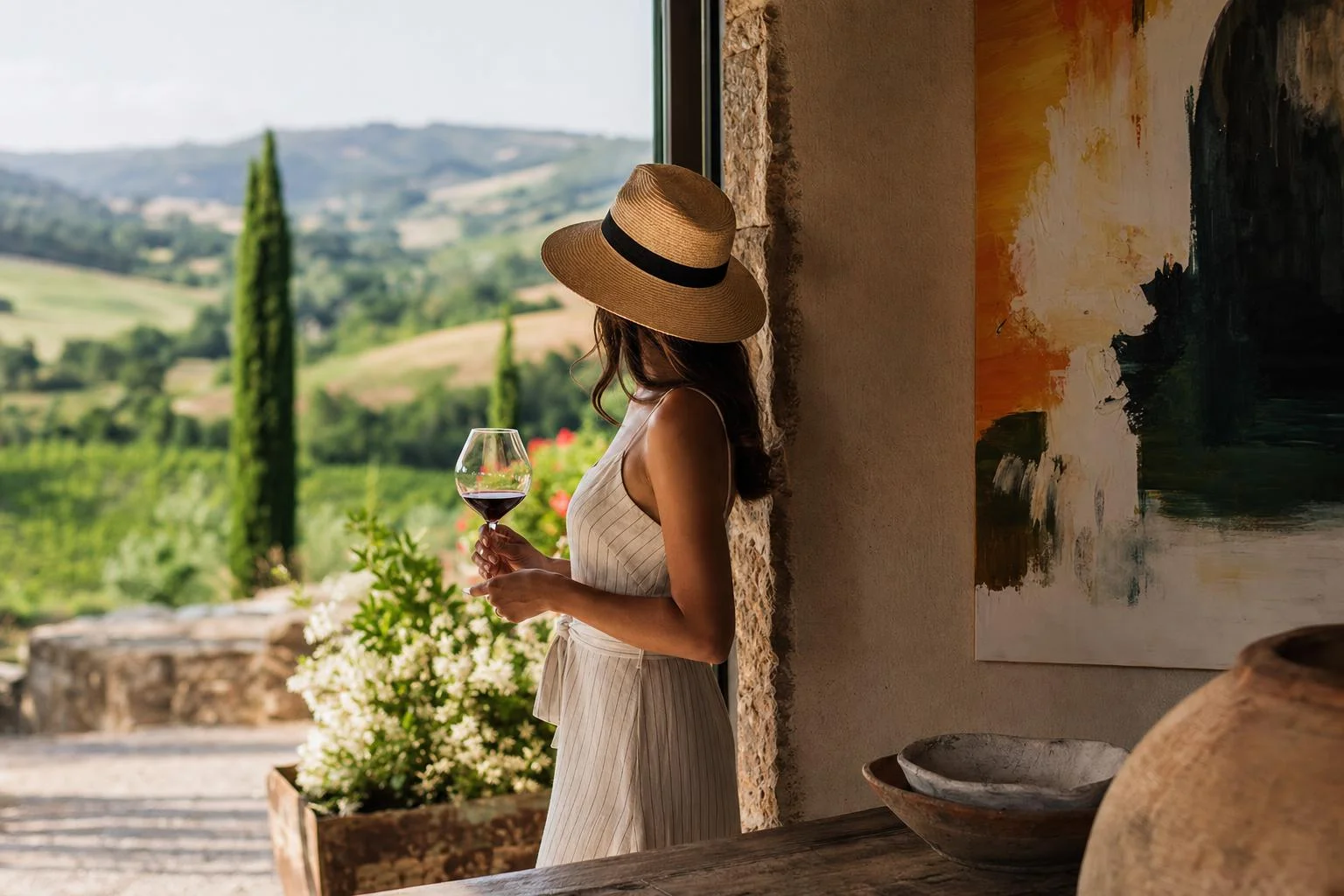
Tuscany is a region that has something to offer in every season, but August carries a particular drama of its own — the vineyards are held in a tense stillness ahead of the great harvest, while the galleries of Florence and Siena host special summer exhibitions that appear only once a year. For lovers of wine and art who know what they are looking for, this is in fact the most complete moment to experience Tuscany as a whole — its land, its culture, and a bottle of fine Brunello or Chianti that has absorbed all of it.
Vineyard phenology: what exactly happens in August
August in the Tuscan vineyards corresponds to the key phenological stage that winemakers call véraison — the moment when the berries begin to change colour, from green to red or gold, and when the intense accumulation of sugars, anthocyanins and aromatic compounds begins within them. For a visitor who wishes to understand wine in depth, rather than simply enjoy a glass, this is the richest visual and educational moment of the year. The vines are in full leaf, the clusters hang low and heavy, and it is the winemaker's skill — and the mercy of the weather — that determines whether the harvest will be exceptional or merely good.
In celebrated appellations such as Montalcino, Montepulciano and Chianti Classico, winemakers carry out intensive green work in August — removing leaves around the clusters to improve ventilation and sun exposure, and sometimes thinning the bunches to increase concentration in those that remain. A knowledgeable guide leading you through the vineyard at this moment can explain each of those decisions in the field, leaf by leaf, cluster by cluster. That kind of experience cannot be gained from a book or a documentary.
Temperatures are high in August, but the altitude of the Tuscan vineyards — Montalcino sits at around 560 metres, many Chianti Classico vineyards between 300 and 600 metres — means that morning visits are cool and pleasant. The difference between daytime and night-time temperatures, the so-called escursione termica, is most pronounced in August and is crucial to the development of elegant aromas in the grapes. Understanding this geographical and climatic logic changes the way you listen to a wine.
Harvest on the threshold: what this means for cellar tastings
Although the Sangiovese harvest in Tuscany most commonly begins in the first half of September (and Brunello di Montalcino sometimes not until late September), the cellars are already in full preparatory swing in August. Barrels have been inspected, tanks sanitised and the team is at full strength. For the visitor, this means something invaluable: the winemakers are present, focused, and delighted to talk about their work, standing as they are on the threshold of the moment that justifies an entire year of effort.
Many smaller family wineries — the so-called aziende agricole — offer barrel tastings of young wines still in the process of ageing during August, an experience that is simply not available outside a scheduled visit. You can compare the same wine at different stages of maturation: in Slavonian oak, French oak, or in concrete eggs that have come back into fashion. Experiencing the difference between those aromatic profiles in a live conversation with the winemaker is far more intense than reading scores in a guide.
It is worth noting that some of the most prestigious wineries, such as those in the Bolgheri or Brunello appellations, are exceptionally popular in August and require reservations several weeks — and sometimes one to two months — in advance. A private visit with a guide who has established relationships with the winemakers is an enormous advantage here: doors open that are quite literally closed to tourists who walk up unannounced.
Summer exhibitions in Florence and Siena: what to see in August
Florence is a city that lives and breathes art throughout the year, but the summer programme brings something rather different from the usual offering of permanent collections. The Uffizi Gallery regularly organises themed guest exhibitions in August that draw loans from museums across Europe — you may encounter drawings by Leonardo da Vinci normally held at Windsor, or Flemish masters exhibited in the context of Tuscan Renaissance patrons. Such exhibitions have a fixed timeframe and are often not repeated.
Palazzo Strozzi, one of Italy's most important institutions for contemporary and modern art, traditionally plans its major summer opening for June or July, meaning the exhibition is still running throughout August and into part of September. The institution is known for interdisciplinary shows that bring Old Masters together with contemporary artists — precisely the kind of combination that appeals to lovers of both wine and art, since both speak of tradition, terroir and innovation.
Siena offers something fundamentally different from Florence: a smaller city, fewer crowds, yet an equally rich cultural offering. The Palazzo Pubblico with Ambrogio Lorenzetti's frescoes — the Allegories of Good and Bad Government — can be visited in August without the queues that are standard during the peak weeks of July. The Complesso Museale Santa Maria della Scala, one of the oldest hospital complexes in Europe to have been converted into a museum, organises evening tours in summer that become an unforgettable experience in their own right.
It is also worth highlighting lesser-known institutions: the Museo Civico in Sansepolcro, birthplace of Piero della Francesca, or the exhibition programme of the Fondazione Zeri near Bologna, which occasionally organises lectures and themed tours available only during the summer months. A curator accompanying the journey can direct your attention to precisely those places that remain off the standard tourist trail, and which are often the most precious of all.
Practical advice: what to book and when
Tuscany is exceptionally busy in August, which means that a spontaneous trip works only if you are content with whatever remains available. For a wine-and-art journey with genuine depth, it is advisable to begin planning at least two to three months in advance. This is not a bureaucratic formality — it is simply that private winery visits, particularly to smaller family estates, require an arrangement made directly with the winemaker, something you cannot achieve through an online form on a tourist portal.
Accommodation is the second critical element. Agriturismo stays — family estates with apartments or rooms — offer an authentic experience and proximity to the vineyards, but in August they are booked up several weeks in advance. Boutique hotels in historic towns such as Montepulciano, Pienza or Radda in Chianti, on the other hand, offer an excellent base from which to explore several zones in a single journey. Your choice of accommodation directly affects the logistics of visits, so it is useful to plan the itinerary and accommodation together rather than separately.
Galleries in Florence and Siena require a separate strategy. The Uffizi operates a timed-entry system with slots that open online thirty days in advance, yet popular time slots sell out within an hour or two. If you use the services of a privately accredited guide, access can often be arranged without a lengthy queue. For exhibitions at Palazzo Strozzi, it is worth purchasing a timed-entry ticket immediately, as capacity during summer weeks is limited.
One practical recommendation for August: plan the coolest part of the day for the vineyards (morning, from 8 to 11 o'clock), and save the gallery experience for the middle of the day when the outdoor heat is at its most intense. In this way, the rhythm of the journey becomes comfortable and natural rather than exhausting. Evenings in Tuscany, meanwhile, belong to a category of their own — an al fresco dinner with local wine on the piazza of an ancient village deserves its own place in the itinerary.
The union of wine and art is no coincidence: why Tuscany offers it better than anywhere else
Few regions in Europe interweave wine culture and the visual arts as seamlessly as Tuscany. Both grew from the same tradition of powerful patrons — the Medici, the Piccolomini, the Aldobrandeschi — who built chapels and planted vineyards in the same breath. Benozzo Gozzoli's fresco in the Palazzo Medici Riccardi in Florence depicts a procession set against a Tuscan landscape that remains instantly recognisable today. To understand one is to understand the other more deeply.
This connection is not merely historical. Many contemporary Tuscan winemakers consciously cultivate that identity — designing their cellars as gallery spaces, collaborating with local artists on labels, and organising cultural programmes. The Antinori winery in Bargino was conceived as an architectural work that sinks into the hillside like a sculpture. Visits to Casanova di Neri or Il Marroneto in Montalcino evoke the same feeling — that wine is the ultimate expression of an aesthetic philosophy, not merely fermented fruit.
For the traveller who arrives with an open mind and a desire to understand rather than simply to consume, August in Tuscany presents a particularly compelling case: everything is simultaneously at its peak. The vineyards are at their most beautiful, the gallery and exhibition programme is at its most varied, and the natural light of a Mediterranean summer makes every landscape and every canvas more vivid. There is no perfect time to visit Tuscany — but August comes surprisingly close to that description.
Where to begin: which zones and towns make an ideal itinerary
An ideal August itinerary combines at least two wine zones and two or three cultural centres. A classic week-long combination might be: two days in Florence with a focus on the Uffizi and Palazzo Strozzi, then moving southwards — through the Chianti Classico zone with winery visits around Greve in Chianti or Radda — followed by a cultural day in Siena, and finally a descent towards Montalcino and Montepulciano for a finale featuring Tuscany's most commanding wines.
Bolgheri on Tuscany's western coast offers an alternative for those wishing to discover a different terrain — this is where Super Tuscans such as Sassicaia and Ornellaia were born, and the landscape along the Tyrrhenian coast is entirely unlike the Tuscan interior. This zone is ideal as an extension of a longer journey or as a standalone mini-route for lovers of modern, internationally oriented wines.
The key is not to try to see everything at once. Tuscany punishes hurried travel — fifteen wineries and twelve museums in seven days means you have been everywhere yet nowhere truly. Three to four wineries and two to three exhibitions over the course of a week, each visited with care and sufficient time for conversation, wine and silence before a painting — that is the measure which pays Tuscany its proper respect.
Tuscany in August is not merely a tourist destination — it is a stage upon which wine and art are simultaneously offered in their most mature form, much like the grapes awaiting harvest. For a journey that goes beyond surface-level sightseeing and in which every winery or gallery visit has its own story, it is worth relying on someone who knows both the people and the place. Artvino & Co. crafts precisely these kinds of journeys — tailored to your wishes, at your pace, guided by experts who know Tuscany from the inside. Share your idea and dates with us, and we will put together an itinerary you will not forget.
Frequently Asked Questions
Is August too hot for visiting Tuscan vineyards?
Temperatures are high, but the vineyards sit at elevations of 300 to 600 metres, making morning visits (before 11 o'clock) very pleasant. Gallery experiences are planned for the middle of the day, while evenings in Tuscan hilltowns are exceptionally agreeable. With a well-planned rhythm, summer is no obstacle — on the contrary, the landscape and light are at their most striking.
Should I book winery visits in Tuscany in advance?
Yes — at least two to four weeks ahead for smaller family-run wineries, and up to two months for prestigious estates such as those in the Brunello appellation or the Bolgheri zone. A private guide with established relationships with the winemakers can secure visits that are otherwise closed to general visitors.
What are the most important summer exhibitions in Florence not to be missed?
Alongside the permanent collections of the Uffizi, Palazzo Strozzi regularly hosts a major thematic exhibition open throughout the summer. Do check the Museo degli Innocenti and Museo di San Marco, which organise special evening visits in summer. It is always worth checking the programme and purchasing tickets in advance, as capacity in August is limited.
Can I combine Tuscan wineries and galleries in a single week-long trip?
Absolutely — it is in fact a natural combination. The recommendation is to dedicate mornings to vineyards and cellars, and afternoons and early evenings to cultural institutions and a stroll through town. An ideal week-long itinerary takes in Florence, Chianti Classico, Siena and Montalcino — each of these places offers both wine and culture at the highest level.
Do you have a date or destination in mind? Contact Artvino & Co. and together we will shape your Tuscan journey — from the first vineyard to the last gallery.
Request a quote