Blog
How to preserve a painting bought on your travels: the frame, humidity and the wall you hang it on
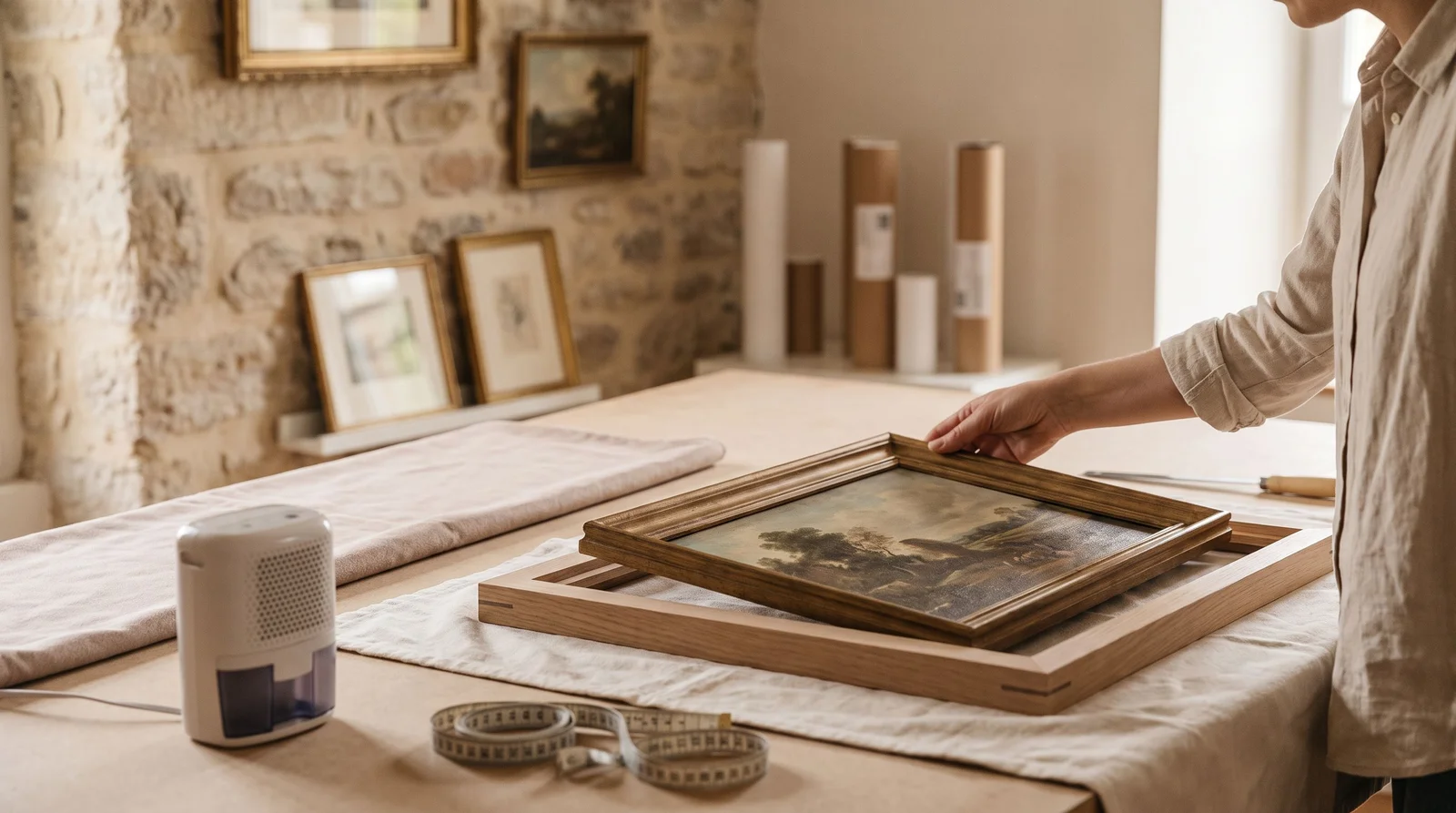
A painting bought in a small gallery somewhere along the wine-growing hills or in a stone lane of a coastal town carries a story with it — about the journey, about the artist, about the moment you chose it. Yet that same story continues once the piece arrives home, because canvas, paper and frame live in a space with its own humidity, temperature and light. Croatian homes, whether by the sea or further inland, present their own challenges for the longevity of artworks. Below we offer concrete advice on how to choose the right wall, protect the piece from humidity and sun, avoid damage from heating, and recognise the moment when professional restoration or reframing is needed.
Why placement matters more than you think
An artwork responds to its surroundings much more slowly and quietly than, say, furniture, so damage is often noticed only once it has already occurred. Colour can fade, canvas can tighten or slacken, paper can yellow, and a frame can crack — all gradually, over months or years. That is why the best protection is the kind you think about in advance, before you hang the painting on the first available wall.
There are three main enemies of any framed painting: direct sunlight, fluctuations in humidity and temperature, and mechanical contact or vibrations. Every wall in a home combines these three factors differently, so choosing a spot really means assessing which wall is least exposed to these risks while still being prominent enough for the piece to truly come alive in the space.
Choosing the wall: light, orientation and distance from sources of moisture
The ideal wall for a painting is one facing north or east, where sunlight enters indirectly and at a weaker intensity, especially during the hours when it is strongest. Walls facing south and west receive strong afternoon sun which, over time, bleaches pigments, dries out the canvas and makes the colour of a figure or landscape noticeably paler after a few years of exposure. If such a wall is the only option, the piece should be protected with a curtain, blind or UV-filtering glass, which significantly reduces the penetration of harmful radiation.
It is equally important to avoid walls next to bathrooms, kitchens and the external walls of coastal houses, where moisture from the air condenses and seeps through the plaster. The external walls of older coastal houses, especially on ground floors, tend to retain moisture from the soil and the walls themselves, so it is better to hang the painting on an internal, partition wall away from the building's outer shell. In continental homes with central heating, the problem is reversed — overly dry air in winter can dry out the wood of the frame and the canvas, so a room with a humidifier, or at least one green plant, helps maintain a more stable climate.
The distance from the floor and ceiling also plays a role: a painting hung too close to the floor is more exposed to moisture that lingers near the ground, while one too close to the ceiling suffers greater temperature fluctuations, as warm air always rises.
Moisture: a specific challenge for coastal and continental homes
Coastal homes, particularly on islands such as Krk, face salty sea moisture that penetrates through windows, balcony doors and old walls. This moisture affects not only the canvas but also the back of the frame, the stretcher bar and the structure from which the painting hangs — wood swells, metal parts rust, and the adhesive holding the canvas taut on the stretcher can give way. It is recommended that there always be a small gap, a few millimetres, between the painting and the wall, allowing air circulation and preventing condensation from forming between the artwork and the wall — this is easily achieved with small cork or silicone pads on the back of the frame.
In continental houses the problem is different: in winter the air is very dry due to heating, while in summer it is humid, so the artwork undergoes sudden seasonal changes. Such fluctuations are particularly dangerous for paintings on wooden panels or old paper works, as the material expands and contracts, which over the long term causes the varnish to crack or the paper to warp. Maintaining relative humidity within the range recommended by restorers for residential spaces, while avoiding sudden changes, is the best way to slow down this process.
Good practice in both climates is to occasionally, at least once or twice a year, check the back of the frame and the edge of the canvas — if you notice stains, a musty smell, small traces of mould or discolouration of the canvas along the edge, these are early signs that the artwork needs to be relocated or requires professional intervention.
Heating, air conditioning and air currents
Radiators, fireplaces and air conditioning units create local heat and air currents that are not visible to the eye but have a significant effect on artwork. The golden rule is that a painting should be kept at least a metre away from any heat source, and ideally more, as warm rising air dries out the canvas and paint and can, over time, cause the varnish directly above the heat source to darken — a phenomenon restorers recognise as a typical sign of a painting having hung above a radiator or stove for many years.
Air conditioning units positioned so that the airflow is directed straight at the painting are equally problematic, as they create sudden changes in temperature and humidity on the surface of the artwork, which can cause micro-cracks in the paint layer over time. When planning the layout of furniture and appliances in a room, think of the painting as a member of the interior sensitive to air currents, just as you would consider a plant or wooden furniture.
In stone houses with open fireplaces, particular attention should be paid to soot and smoke, which, although barely visible, settle on the surface of the artwork over time and alter the tone of the varnish. If the fireplace is the main source of heating, it is better to hang the painting in an adjoining room or at least on the wall furthest from the hearth.
Regular cleaning and handling of the frame
Dust is the most common, yet most neglected, enemy of framed artworks. It accumulates on the frame, on the glass if the painting has any, and on the edges of the canvas, and over time acts abrasively and attracts moisture. A dry, soft microfibre cloth is sufficient for cleaning the frame, gently passing over the wood or gilding without pressure; for the glass, a lightly dampened cloth should be used — never spray directly onto the glass, as liquid can slip beneath the edges and reach the artwork itself.
You should never clean the surface of a canvas or paper yourself, not even with a dry cloth or brush — the pigment, varnish and patina of an old oil painting are very sensitive and can easily be damaged even by something that seems harmless, like wiping with a finger or a damp tissue. If you notice dust, a stain or a change in the varnish's sheen on the surface, this is a task for a conservator-restorer, not for home care.
When moving a painting, always carry it upright, holding it by the edge of the frame with both hands, never by the wire or cord it hangs from, as this weakens over time and isn't designed to bear the full weight during transport. If the piece is moving from one home to another, or won't be displayed for a longer period, store it upright, wrapped in acid-free, unprinted paper, away from basements and attics where humidity and temperature fluctuate the most.
The frame: when to replace it and when to preserve the original
A frame bought together with the piece while travelling often carries its own aesthetic and sometimes historical value, particularly if it's handmade or part of the tradition of the region where you bought it, so the decision to replace it shouldn't be made lightly. Still, there are clear signs that a frame is no longer serving its protective function: visibly warped wood, cracks in the corners, loosened joints causing the canvas to no longer be evenly stretched, or glass without UV protection.
Transferring the work into a new frame, so-called reframing, makes sense when the existing frame endangers only the canvas — for instance, if the wood of the stretcher is rotting from moisture or if metal tacks have rusted and are damaging the edge of the canvas. In such cases, a restorer can keep the original decorative frame as the outer part, while fitting a new, stable stretcher inside it that protects the work, thereby combining preservation of appearance with functional protection.
When choosing a new frame for coastal conditions, materials more resistant to moisture are recommended, such as treated wood or aluminium profiles, combined with glass that filters UV rays. For continental homes with heating, the stability of the wood against temperature fluctuations matters more, so it's worth looking for frames made from well-dried, treated wood.
When it's time to call in a restoration expert
There are several clear signals that you can no longer, and shouldn't, intervene on a work yourself. If you notice patches of mould, whitish stains on the surface of the varnish, bubbling or flaking paint, spreading creases in the canvas, or a smell of damp coming from the painting itself, an assessment by a conservator-restorer is needed before the damage spreads. The same applies to works on paper with damp stains or yellowing spreading from the edges towards the centre.
The restorer will first carry out an assessment of the condition, determine the cause of the damage — whether it's moisture, light, previous poor cleaning or the age of the materials — and only then propose an intervention, which might be a simple cleaning of the varnish, securing the canvas to a new stretcher, or more extensive conservation of the pigment. Look for a specialist trained in the conservation-restoration of artworks, not a general framing service, as an improper intervention can irreversibly damage the original surface.
It's also good practice to have a preventive inspection of your more valuable travel keepsakes roughly every few years, even if there are no visible problems, particularly if the piece is older or made using a traditional technique such as oil on canvas or watercolour on paper. Such an inspection catches changes in time that are difficult for the eye to notice from day to day, but which reveal much more to a restorer about the condition of the materials.
A painting bought in a small gallery beside a vineyard, or in a lane of a coastal town, deserves the same attention we gave it at the moment of choosing it — because the right place on the wall, stable humidity and distance from heat make the difference between a work that fades within ten years and one that remains vivid for decades. If you are unsure whether your wall is the right choice, or you notice the first signs of damp, changes to the canvas or a problem with the frame, we are happy to help with advice or point you to the right restoration specialist. Get in touch with a question or a photograph of the work — we would be glad to exchange a few words about how best to preserve the memory of your journey.
Frequently Asked Questions
Which wall in the house is best for hanging a painting bought while travelling?
The best choice is an interior wall facing north or east, away from bathrooms, exterior walls by the sea and sources of heat, as such a wall offers more stable temperature, lower humidity and weaker direct sunlight.
How do you protect a painting from damp in a coastal house?
Leave a small gap between the frame and the wall for air circulation, avoid exterior and ground-floor walls, and periodically check the back of the frame for signs of moisture or mould.
Can I clean a framed painting myself at home?
You can clean the frame and glass with a dry or lightly dampened soft cloth, but you should never clean the surface of the canvas or paper yourself — this requires a conservator-restorer.
When does a painting need professional restoration?
When you notice mould, bubbling or flaking paint, creases in the canvas, a smell of damp or spreading yellowing of paper, it is time for an assessment by a conservator-restorer before the damage progresses.
Have a question about caring for a painting bought while travelling or in our Art Store? Contact us and we will be happy to advise you on the best solution.
Get in touch